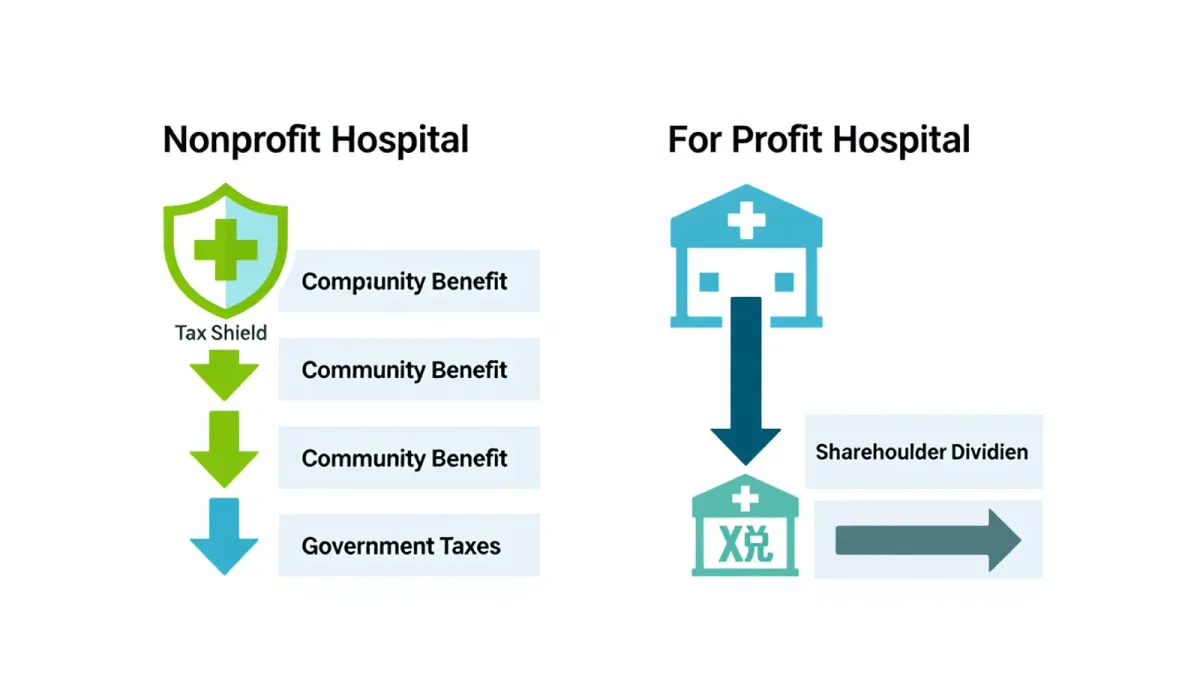
Roughly three of every five US community hospitals are nonprofit, about a quarter are for-profit, and the rest are state or local government facilities, per American Hospital Association annual survey data. The nonprofit share surprises people who assume American health care is a for-profit industry, and it matters financially: nonprofits are exempt from federal and state income taxes and, in most states, from property and sales taxes on their facilities. In exchange they owe communities benefit. What that benefit is, and whether patients receive different care under each structure, is the subject this article untangles.
This article publishes information, not medical or insurance advice. Care decisions belong with clinicians; tax-status questions here concern institutional structure and billing, not treatment choices.
What tax exemption requires
Federal rules under IRS Section 501(r), in force since 2010 with tightened enforcement since 2015, require nonprofit hospitals to do four things: maintain a written financial assistance policy; charge means-tested amounts for patients who qualify for assistance; limit charges to amounts generally billed to insured patients — no charging uninsured patients the full chargemaster rate; and make reasonable efforts to determine a patient's assistance eligibility before pursuing extraordinary collection actions, with at least 120 days after the first bill before any such action. On top of these requirements, nonprofits must conduct a community health needs assessment every three years and adopt implementation strategies. The enforcement stick exists: the IRS has revoked nonprofit status in individual cases, and state attorneys general oversee charitable assets.
What community benefit actually counts
The accounting matters more than the label. Nonprofits report community benefit spending on IRS Schedule H forms, and the categories are unequal: charity care — free or discounted care to patients who cannot pay — sits alongside Medicaid underpayment (the gap between Medicaid payment and hospital cost), health professions education, subsidized health services, research, and cash and in-kind contributions. Analyses of Schedule H filings, including work by the Kaiser Family Foundation and academic researchers, consistently find that charity care is a minority of total reported benefit at many systems, and that Medicaid shortfall — an accounting of unpaid costs rather than a giveaway — can dominate the total. Critics, including the Lown Institute with its Hospital Index, have argued that many nonprofits receive tax exemptions exceeding their measurable charity output; defenders note that teaching, research and subsidized services serve the same public purpose. Both observations can be true, and they are the core of an ongoing policy fight.
The enforcement record so far
How often do the rules bite? Data points exist on both sides. The IRS and state attorneys general have acted in individual cases, and several state-level property tax fights, most prominently in Illinois, forced legislative fixes defining how much charity justifies exemption. On the consumer side, nonprofit billing collections have drawn federal scrutiny: congressional inquiries and investigative reporting in 2023 and 2024 documented nonprofit systems suing patients over bills while reporting large surpluses, which pushed several large systems to pause lawsuits and revise assistance thresholds. Patient advocates count a practical asymmetry: the 501(r) protections are strong on paper but activate only when patients claim them, so financial assistance uptake remains low relative to eligibility in most systems that have measured it. The gap between policy and take-up is where most of the recoverable money sits.
Does care differ by ownership?
On the dimensions patients feel, the differences are smaller than the structures suggest:
- Quality. Peer-reviewed comparisons using Medicare star measures, mortality and readmissions find overlapping distributions, with for-profit hospitals slightly overrepresented among poor performers in some studies and nonprofit systems among leaders in others; ownership alone explains little.
- Prices. The consolidation literature, covered separately on this site, finds nonprofit systems negotiate prices as aggressively as for-profits; nonprofit status does not produce lower commercial rates.
- Charity care. For-profits generally spend little on charity care, as expected — roughly 1 to 2 percent of expenses in industry aggregates — while nonprofit charity spending varies enormously by system, with some religious and safety-net-affiliated systems far above average.
- Profits. Nonprofits earn operating margins, and several large nonprofit systems hold investment portfolios in the billions. The difference is what happens to surplus: reinvestment and reserves versus distributions and taxes.
How this reaches your bill
Three practical connections exist. First, if you are uninsured or underinsured and treated at a nonprofit hospital, the financial assistance policy is a legal right, not a favor — apply, and note the 120-day collection rule. Second, charging rules protect assistance-eligible patients from chargemaster rates at nonprofits, which is one reason an uninsured bill at a nonprofit hospital can shrink dramatically after application. Third, if you live in a state with a hospital tax exemption fight — several legislatures have debated minimum charity thresholds — the Schedule H data for your local system are public, and the comparisons are concrete.
What to watch
Pressure on the nonprofit bargain is building from several directions: federal and state scrutiny of whether Medicaid shortfall should count as community benefit, proposals for minimum charity care floors as a condition of exemption, consolidation-driven margin growth at flagship systems, and Illinois-style court and legislative fights over property tax exemptions that have recurred for a decade. The durable consumer rule: ownership labels tell you which rules apply, but the bill you actually receive depends on applying those rules — asking for the financial assistance policy in writing is the step most patients never take.