Your deductible is the amount you pay for covered care each plan year before your insurer begins sharing costs; your out-of-pocket maximum is the absolute ceiling on what you pay for covered in-network care in that year. The two are related but not the same: the deductible always sits below the out-of-pocket maximum, and everything you pay toward the deductible counts toward the maximum, but copays and coinsurance paid after the deductible only count toward the maximum. For 2026, the Affordable Care Act caps the out-of-pocket maximum for marketplace and most employer plans at 10,600 dollars for individual coverage and 21,200 dollars for a family, per CMS guidance for the 2026 plan year.
This article is information, not medical or insurance advice. Cost-sharing limits change every year and vary by plan; the only authoritative source for your coverage is your plan's Summary of Benefits and Coverage and, for questions about your specific situation, a licensed broker, your benefits department or your insurer directly.
How the cost ladder actually works
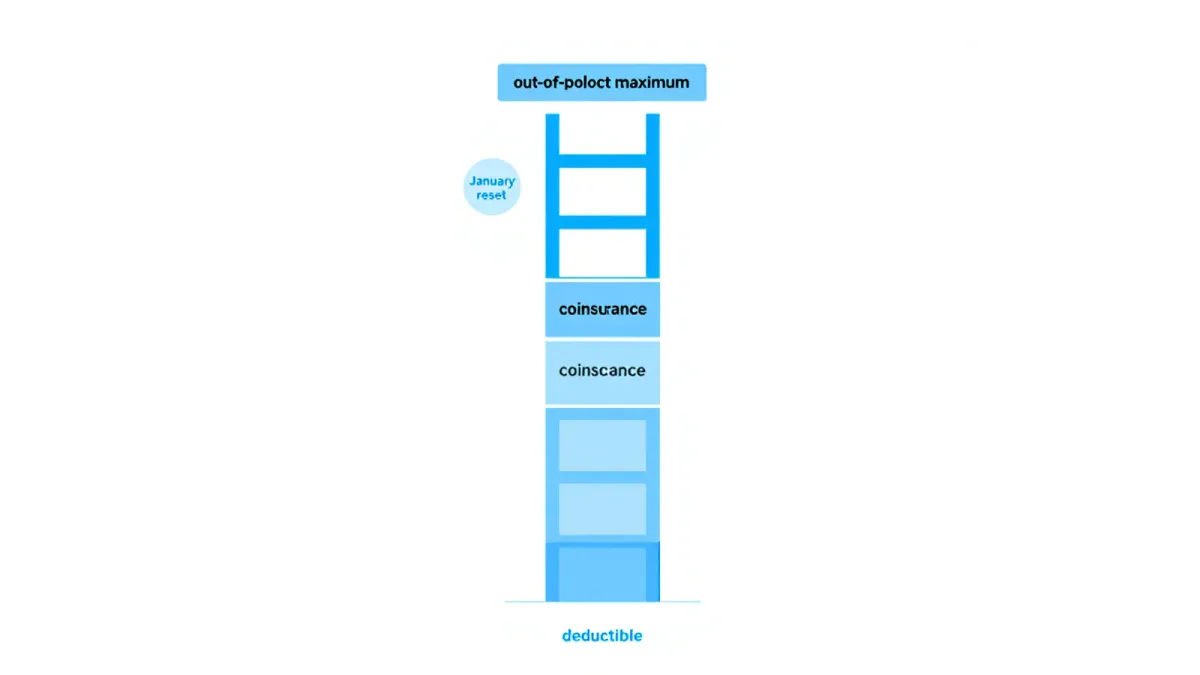
Picture four rungs. First, you pay your full negotiated price for care until spending reaches the deductible. Second, cost sharing kicks in: you pay a percentage (coinsurance) or a flat fee (copay) while the plan picks up the rest. Third, once your total payments for covered in-network services reach the out-of-pocket maximum, the plan pays 100 percent of covered in-network care for the rest of the year. Fourth, the whole ladder resets on January 1 or whenever your plan year begins.
A worked example: suppose your plan has a 3,000 dollar deductible, 20 percent coinsurance and a 7,500 dollar out-of-pocket maximum. If you have a 15,000 dollar hospitalization, you first pay 3,000. On the remaining 12,000 you owe 20 percent — 2,400 — and the plan owes 80 percent. Your total is 5,400, well under the 7,500 ceiling, so you never hit the maximum that year. Had the bill been 60,000 dollars, you would have stopped paying at 7,500 and the plan would have covered everything after that.
What counts toward the out-of-pocket maximum — and what does not
The ACA defines precisely which payments count. Monthly premiums never count. Amounts billed for out-of-network care generally do not count toward the limit, because the legal ceiling applies only to in-network covered services. Balance billing from out-of-network providers who are not protected by the No Surprises Act also does not count. Items your plan simply does not cover — cosmetic procedures, for example — fall outside the ladder entirely. That distinction is where many families get burned: a 12,000 dollar out-of-network plastic-surgery bill does not nudge you toward your maximum one dollar.
- Counts: deductibles, coinsurance, copays, and usually deductibles applied to prescription drugs, if the drug benefit is integrated with the medical benefit.
- Does not count: premiums, out-of-network cost sharing (except emergency care protected by federal law), non-covered services, and charges above what the plan recognizes as the negotiated rate.
Why a plan can have a deductible for some services and not others
Plans routinely exempt certain services from the deductible. Under ACA rules, preventive care — annual physicals, most screenings and recommended immunizations — must be covered with no cost sharing when you use an in-network provider, regardless of your deductible. Many employer plans also apply flat copays to primary care visits and generic drugs from day one. So a person with a 5,000 dollar deductible may pay nothing for a colonoscopy screening yet face the full cost for an MRI. Read the plan's coverage table row by row rather than assuming the deductible applies uniformly.
Embedded versus aggregate family deductibles
Family coverage adds a trap. In an embedded structure, each family member has an individual out-of-pocket limit — no single person can be charged more than the individual maximum even on a family plan. In an aggregate structure, the full family maximum must be met before anyone gets full coverage. Federal rules for ACA-compliant plans require that an individual's cost sharing stop at the individual ceiling even on family policies, effectively mandating embedded structures for most plans — but older grandfathered and some self-funded employer arrangements can differ. If you carry family coverage, ask your plan administrator one direct question: does any single member's cost sharing stop at the individual limit?
How to use both numbers when choosing a plan
The deductible answers one question — how much of the first chunk of care is on me. The out-of-pocket maximum answers the bigger one — how bad can my worst-case year get. If you have a chronic condition, planned surgery or an unpredictable diagnosis in the household, the out-of-pocket maximum is often the more important number, because one serious event drives you past the deductible and into the zone where the ceiling governs. If you expect minimal care, the deductible and premium matter more, because you may never get near the ceiling. Compare plans on the maximum you could realistically owe: premium times twelve, plus the out-of-pocket maximum, is your true worst case for the year.
What to do next
Pull your current plan's numbers and compute your own worst case, then repeat the math for any plan you are considering this enrollment season. If a hospitalization already happened this year, check your spending against the maximum — hitting it means every remaining covered in-network service in the plan year should be billed at zero cost sharing, and errors in that tracking are common enough to warrant a call to the insurer's member services line.