
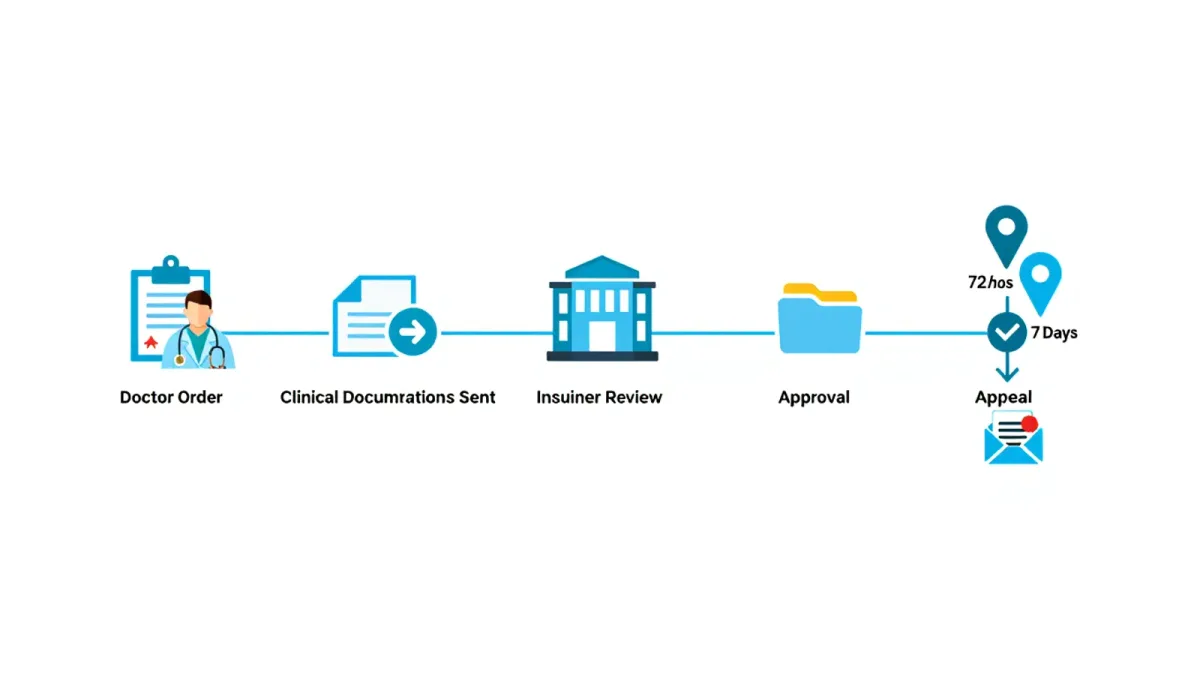
Prior authorization is an insurer's requirement that a doctor obtain advance approval before a specific service, drug or device is covered. Nothing in your benefit document guarantees payment for a listed service if the plan's rules demand pre-approval and nobody asked. The scale is large: an American Medical Association physician survey has found practices handle roughly 39 to 43 prior authorizations per physician per week, and about a quarter of those are sometimes abandoned when the process stalls — meaning some care never happens at all. CMS has issued rules for 2026 that streamline electronic prior authorization and shorten response times for many services in Medicare Advantage, Medicaid and marketplace plans, with decisions generally due within 72 hours for expedited requests and seven calendar days for standard ones.
This article is information, not medical or insurance advice. Authorization rules are plan-specific and change annually; your plan documents and member-services line are the controlling sources, and a denial can always be discussed with your clinician and appealed.
Why the requirement exists
Insurers describe prior authorization as a cost and safety check: some drugs are dangerous without documented trial of cheaper first-line options, some imaging is ordered routinely when guidelines do not support it, and site-of-care rules steer infusions to home or office settings that cost a fraction of hospital rates. Critics, including the AMA and multiple provider groups, counter that the process substitutes clerical gatekeeping for clinical judgment and delays care whose clinical value is already established. Both things are true in different cases, which is why knowing where your particular service sits matters: a specialty biologic with cheaper alternatives is a genuinely contested decision; an MRI for persistent neurological symptoms after a guideline-listed workup is usually approved on submission of the right documentation.
Who actually files the request — and why you should still track it
The prescribing or ordering provider submits the request, not you. It goes to the insurer with clinical notes, prior treatments tried, and guideline references. But the patient is the one with time pressure and the one who suffers when a file sits in someone's queue. The practical division of labor that works: ask the practice which staff member owns authorizations, get the reference number once the request is submitted, and check status weekly through the insurer portal. If you switched plans in January, expect heavier backlogs — authorization volumes spike at plan-year changes.
- Get the CPT or NDC code. Ask your doctor's office for the exact procedure or drug code being requested; conversations about status are meaningless without it.
- Ask which clock applies. Standard requests allow days; urgent requests — where delay could seriously jeopardize health — must be answered within 72 hours under federal rules for regulated plans.
- Confirm network status of the facility. Approval for the service does not guarantee the imaging center or infusion site is in network.
What happens when a request is denied
A denial letter must state the specific reason and your appeal rights. Common reasons are fixable: missing documentation, no documented trial of a preferred drug, or a coding error. An internal appeal asks the insurer to reconsider, and an independent external review — available for many plans — moves the decision to reviewers unaffiliated with the insurer, where a substantial share of overturned denials in studies by the federal Consumer Assistance programs have favored the patient. Your clinician's peer-to-peer call with the plan's medical director often resolves disputes faster than any paperwork: it is always worth requesting one before escalating.
Drugs are a special case
Pharmacy prior authorization runs through the pharmacy benefit manager and the plan formulary, with its own vocabulary: step therapy (must try cheaper drugs first), quantity limits, and non-formulary status. When a prescription is rejected at the counter, the pharmacist sees only a generic code. The remedy is a formulary exception request from your prescriber, supported by a statement that preferred alternatives are ineffective or harmful for you. For brand drugs with recent price increases, check whether a therapeutic alternative exists — the fastest approval is the one that matches the formulary's default tier.
How to make your next authorization uneventful
Before scheduling any costly service, call member services and ask three questions: does this code require prior authorization under my current plan, who files it, and what documentation typically triggers approval. If you are choosing plans during open enrollment and you have known specialty needs, compare the plans' prior authorization lists — published annually — not just their premiums. And if an authorization is approved, note its expiration date: many approvals are valid only for a defined window, and a rescheduled procedure after expiry needs a new request.
Timing also depends on who notices the stall. Authorization systems generate no automatic updates to patients; the request simply ages. Practices under staffing pressure may wait for the plan to respond even when the 72-hour expedited window has lapsed — which is a violation of the plan obligations, not a reason to give up. A documented call to member services noting the missed clock, followed by escalation to the appeals coordinator, is the standard cure. Keep a simple log: date, reference number, name of the representative, what was promised. Plans that miss regulatory deadlines face corrective action under state insurance department oversight, and your log is the evidence that makes such complaints actionable.
What to watch
Federal policy is moving toward fewer, faster and more electronic prior authorizations — CMS rules effective in 2026 require real-time responses for many requests and public reporting of denial rates for Medicare Advantage and marketplace plans. If your plan's denial rates appear in that data, it is now public information worth checking before you renew.