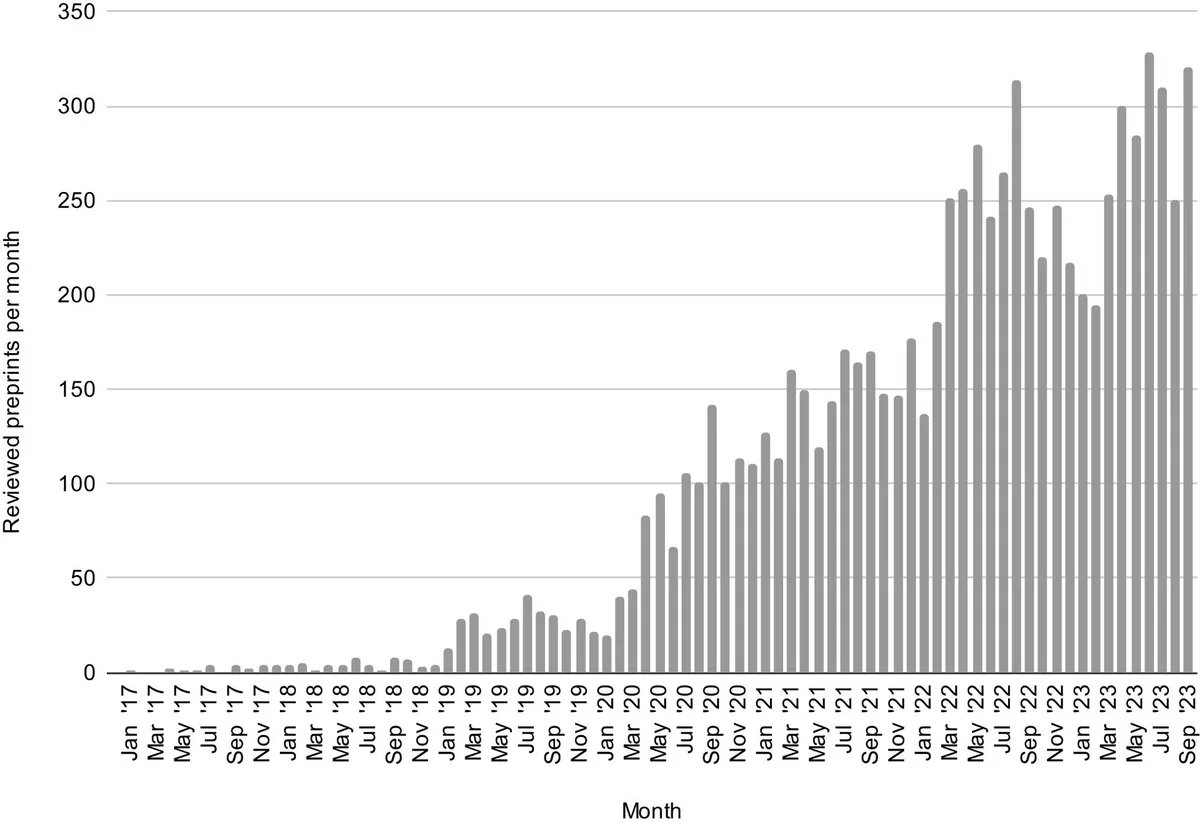

A preprint is a scientific paper posted online before any journal has reviewed it; a peer-reviewed paper has passed examination by independent experts before publication. The distinction matters for every health headline you read, because a large share of widely covered studies — the practice accelerated during COVID-19, when preprints became primary channels for results — begin as unreviewed manuscripts. The server medRxiv, launched in 2019, alone posts thousands of health-science preprints each year, and journalists routinely cover them the same week they appear, before any reviewer has checked the statistics or the conclusions.
Publishing status is not a verdict on quality — errors and breakthroughs appear in both channels — but it is a necessary fact to know before changing anything about your treatment, diet or medication on the strength of a single study. Decisions belong with you and your clinician.
How to tell what you are looking at
Open the paper and check three places. First, the site: bioRxiv, medRxiv, arXiv and SSRN are preprint servers; journals such as JAMA, BMJ or Nature publish reviewed work. Second, the banner: preprint servers stamp pages with disclaimers stating the paper is not peer reviewed and should not guide clinical practice. Third, the version history: journals often link a reviewed “version of record,” and the DOI prefix of a preprint differs from its published version. None of this is hidden — it is simply rarely mentioned in the headline.
A subtlety worth knowing: peer review is not a replication. Reviewers judge whether methods justify conclusions; they do not rerun experiments. A peer-reviewed paper can still be wrong, unreproducible, or overturned — review raises the floor of plausibility, not certainty. Conversely, some of the most consequential results of recent decades, including early mRNA vaccine efficacy reports, appeared as preprints within days of data lock, and review afterward changed little.
What review actually screens for
Reviewers evaluate whether the study design fits the question, whether statistics support the claims, whether limitations are disclosed, and whether conclusions overreach the data. They commonly catch confounding that authors missed, inappropriate endpoints, and selective reporting. What they cannot catch: fabricated data, results that only replicate years later, or honest conclusions that larger studies later overturn. Journals also differ enormously in review rigor; a letter, a case report and a randomized trial all arrive as “published” citations in your news feed with equal typographic confidence.
Why preprints exist at all
Traditional publication takes months; journal backlogs and peer-review rounds delay findings while the science moves. Preprints make results public within days, allow the community to critique work immediately, and establish priority for the authors. Public-health emergencies made the tradeoff explicit: waiting for review during a pandemic had a cost measured in lives, so agencies and journals explicitly endorsed rapid preprint posting with concurrent review. The system worked — and also produced headline-covered preprints that were later withdrawn or fundamentally revised, including prominent early claims about treatments that larger trials later refuted.
A practical weighting scheme
- Preprint, single study, big claim: read as a rumor with data attached. Wait for review and replication before acting; check whether the authors themselves flag limitations prominently.
- Peer-reviewed, single study, big claim: read as a hypothesis that survived expert scrutiny. Ask whether the effect is large, whether the population resembles you, and whether anything similar has replicated.
- Peer-reviewed, replicated, meta-analytic: the weight-bearing wall of medical knowledge. This tier justifies guideline changes and, eventually, your own decisions.
Notice the rule of thumb that falls out: the newer and less-reviewed the source, the bigger the discount the claim deserves. Reporters' deadlines run in hours; replication runs in years.
Institutions are formalizing the distinction too. Major funders including NIH now encourage grantees to post preprints and allow them to be cited in grant applications as research outputs, and journals increasingly accept submissions previously posted as preprints — a once-controversial policy that is now standard across major publishers. The result is a hybrid ecosystem in which publishing status is a stage rather than a binary: preprint, reviewed, revised, replicated. Skepticism should scale down through those stages rather than switching off at the first peer-review stamp.
Why the paper and the headline so often disagree
Press releases compound the problem. University and journal communications offices draft headlines designed for circulation, and a hedged conclusion — “we observed an association in mice” — reliably becomes “scientists say food X prevents cancer” by the third rewrite. Comparing the abstract’s own final sentence with the headline you saw is the fastest audit available: in most mismatched cases, the authors were more careful than the coverage. When the paper itself is only a preprint, that gap widens again, because there was never a reviewer demanding the title match the data.
What to do with the next exciting headline
Before forwarding, sharing or acting on any single-study health claim, spend two minutes finding the paper and checking its status. If it is a preprint, note that the media cycle covered an unreviewed draft. If it is peer-reviewed, look at the sample size and whether the authors' own conclusion matches the headline — overclaiming happens at the headline stage more often than at the paper stage. And for any decision touching your own treatment, the right question for your clinician is not “did you see that study” but “does this change anything given everything else we know” — a question no single paper, reviewed or not, can answer.