
Two people get the same scan at the same clinic. One pays a modest copayment. The other opens a bill that looks like a typo. The difference is usually not the care. It is the contract behind it.
A health insurance policy is a contract. It states in writing which costs are covered and how. For private plans, those details live in a member contract or an Evidence of Coverage booklet. Wikipedia's health insurance overview lays out the pieces. Network status is one of the biggest levers on what you owe.
The Contract Behind the Discount
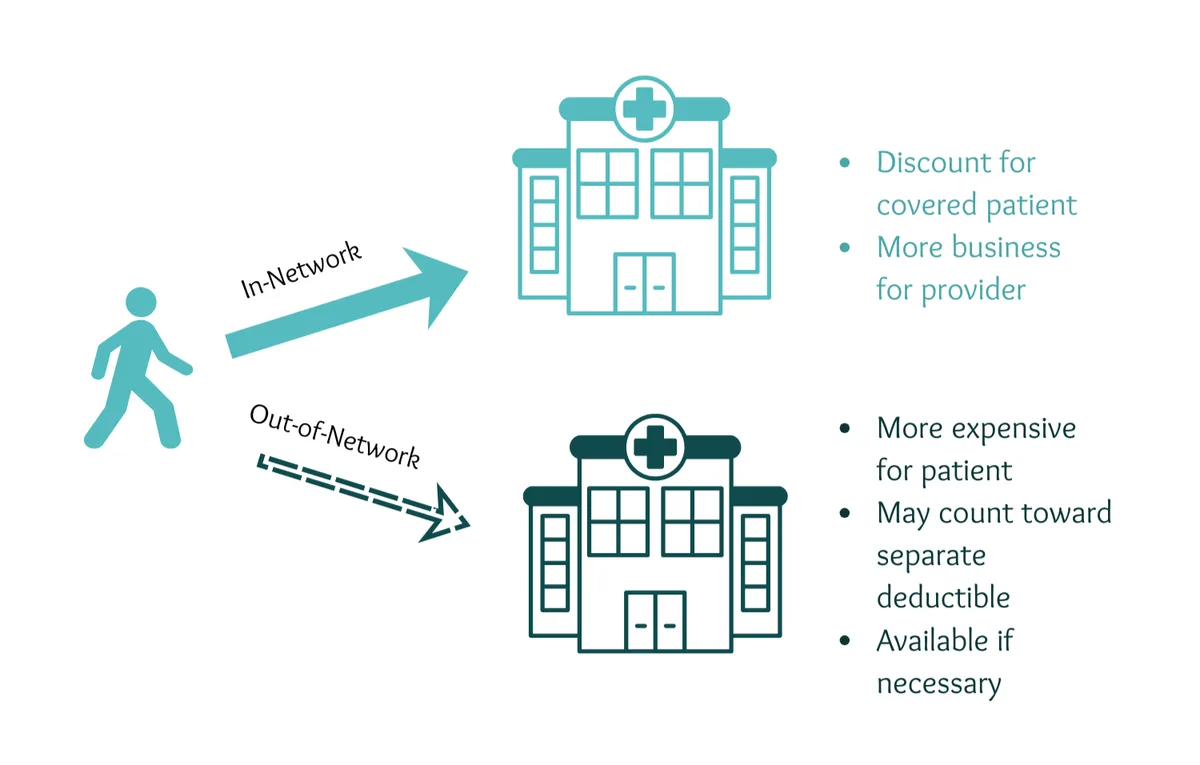
An in-network provider sits on a list preselected by the insurer. The list is built on agreements. In-network providers have a contract with the insurer. They accept rates further discounted from the usual and customary charges paid to out-of-network providers.
Plans steer members toward that list. The insurer offers lower coinsurance or copayments, or extra benefits, to members who stay in it.
What Changes Out of Network
Step off the list and the deal changes. An out-of-network provider has not contracted with the plan. A patient using one may have to pay the full cost of the services received. For related coverage, see CMS Launched an Electronic Prior Authorization Push on May 6.
The plan usually still pays something. But it pays on its own terms. It pays out-of-network providers according to reasonable and customary charges. Those charges may be less than the provider's usual fee. Anything above that can become the patient's share.
That share can be formalized. Many providers will bill the insurance company for you. In exchange, you sign an agreement to pay whatever the insurance does not.
How the Bill Meets Your Deductible and Coinsurance
Network status then meets the standard cost-sharing rules. A deductible is the amount you must pay before the insurer pays its share. It may take several visits or refills before that bar is met. Most policies do not apply copays for doctor's visits or prescriptions against the deductible. A copayment itself is a fixed amount. You pay it each time you get a given service. We covered a connected angle in UnitedHealth Raised Its 2026 Forecast as Cost Ratio Cooled to 86.7 Percent.
Coinsurance works by share instead. It is a percentage of the total cost. You may pay it instead of a copayment, or on top of one. There can be an upper limit on coinsurance. Depending on the real costs of your services, you could end up owing very little or a great deal.
The Ceiling That Ends Your Share
Cost-sharing is not always endless. An out-of-pocket maximum works like a coverage limit in reverse. Your payment duty ends when you reach it. After that, the insurance pays all further covered costs. The cap can apply to all coverage in a benefit year. Or it can be limited to one category, such as prescription drugs.
Other limits are less forgiving. Some policies only pay up to a certain dollar amount. Charges above that cap fall to the insured. And even for emergency services, out-of-network providers may bill patients for some extra costs.
One document pulls the whole picture together. An explanation of benefits may be sent by the insurer. It explains what was covered and how the patient's share was worked out. Reading it against the bill is the simplest way to see each rule at work.
Conclusion: The Network Is the Price List
In-network versus out-of-network is not a status label. It is the gap between two price schedules. One side holds contracted, discounted rates. The other holds reasonable and customary payments, plus a possible share of the rest. Layer in the deductible, copayments, coinsurance, and the out-of-pocket maximum. Then the final number on the bill starts to make sense. Learn your network before care happens, not after the envelope arrives.
This article is general information, not medical or insurance advice. Talk with a qualified provider or licensed agent about your situation.