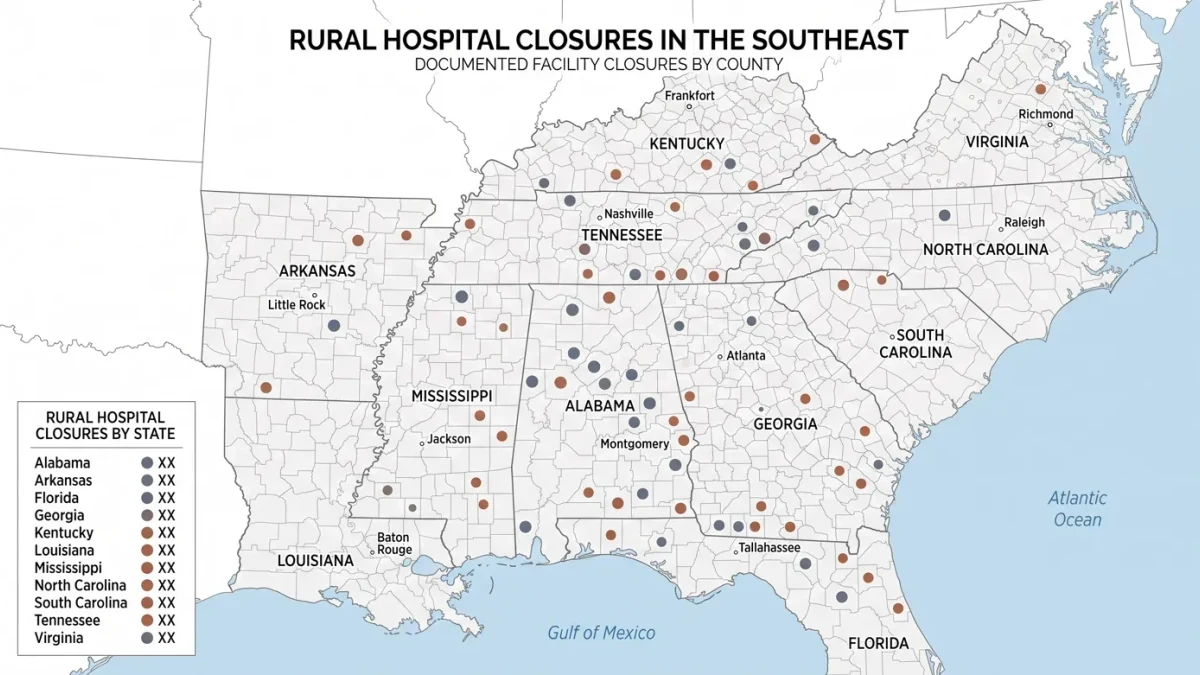

Rural hospitals keep closing because the volume no longer pays for the building. Small towns send fewer inpatients, margins run thin, and every empty staffed bed costs money. The pace of hospitals closing since 2005 stands at 197 closures and conversions, per the University of North Carolina's Sheps Center tracker. The count mixes two different events, and the difference is where the future sits.
The economics reach patient paperwork too: the guide to itemized hospital bill errors shows where charges drift from what was delivered. The Hospitals hub follows closures, conversions, and pricing rules as they land. What follows is the arithmetic, and then the stopgap that Medicare built for towns that lost their wards.
What Do the Closure Numbers Actually Show?
Two counts, kept apart. The Sheps Center tracker lists 197 rural hospital closures and conversions since January 2005: 109 complete closures, where care stopped entirely, and 88 converted closures, where inpatient care stopped but some services stayed. Since 2010 the total is 154, and conversions to Rural Emergency Hospitals sit outside the count.
- Complete closure: the facility no longer provides health care services.
- Converted closure: inpatient care ends, but the site keeps some services, such as primary care or skilled nursing.
- Not counted: conversions to Rural Emergency Hospitals, which the tracker follows on a separate map.
The definitions follow the Office of Inspector General's line: a closed hospital stopped providing general, short-term, acute inpatient care. The carve-outs matter. A merger that keeps inpatient beds open does not land in the count. Neither does a turn into a Critical Access Hospital or a conversion to an REH.
Why Does the Rural Math Stop Working?
Volume is the whole game. A ward needs admissions to cover staffing and the fixed cost of licensure, and small towns no longer produce them. The split in the Sheps data shows the adaptation: 88 of the 197 closures since 2005 were conversions, which means the town kept a clinic or nursing unit by shedding beds.
Congress read the same arithmetic. The Consolidated Appropriations Act, signed on December 27, 2020, created a new Medicare provider type for towns that could no longer fill a ward. CMS wrote the operating terms in a final rule published on November 23, 2022. The design pays for an emergency room, not for beds.
What Is a Rural Emergency Hospital?
A Medicare status built for downgraded hospitals. Under the 2022 final rule, effective January 1, 2023, an REH runs a staffed emergency department 24 hours a day, 7 days a week, and must not provide inpatient services outside a licensed skilled nursing unit. Outpatient department services are paid at the standard hospital rate plus 5 percent.
The extra piece is a monthly facility payment: $272,866 in the first year, per the November 2022 rule, rising each year with the hospital market basket. That payment is the public-money side of the trade. It exists to keep an emergency room open in towns where the beds closed.
Do the Stopgaps Reverse the Trend?
No, and the tracker says so plainly. Sheps treats REH conversions as a separate path rather than saved hospitals, and complete closures still outnumber conversions in the data. A town with an REH keeps round-the-clock emergency access and loses its ward. The trend bends toward smaller units of care, not toward restored hospitals.
The honest frame is a swap, not a rescue. Public money buys local emergency access, and the hospital trades its inpatient license for a steadier payment line. Whether that trade holds depends on staffing, and the rule borrows the staffing requirements used for Critical Access Hospitals.
Conclusion: What Comes Next for Rural Care
The arithmetic will not flip on its own: volumes are what they are, and the payment model now pays for the emergency room instead of the ward. Watch two numbers from here: the complete-closure count at the Sheps Center, and the list of REH conversions on its separate map. Both updates carry dates, and both are checkable. The same caution applies to any decision about local care, since this is information, not medical or insurance advice. For related coverage, see Elevance's New Site-of-Care Billing Rules: What They Mean for Your Bill.