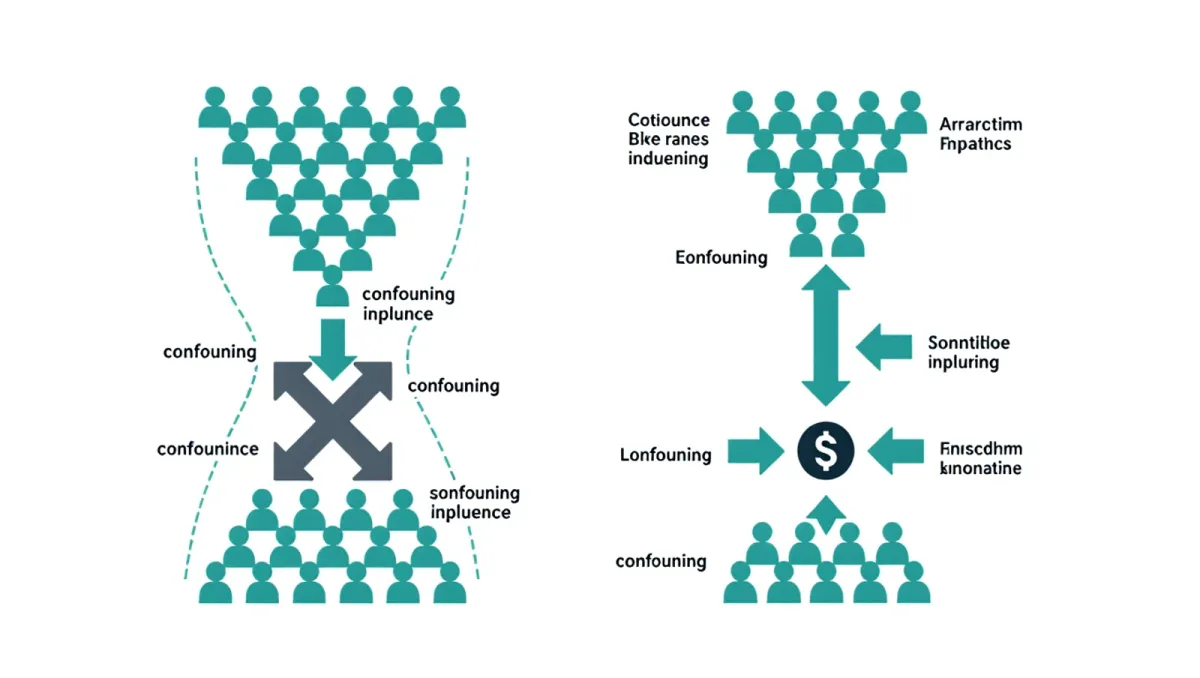
When a headline says a food, vitamin or habit is linked to lower risk, the finding almost always comes from an observational study: researchers tracked large groups for years, recorded who developed an outcome, and compared exposure levels between those who did and did not. Such studies can genuinely say that two things move together, adjusted for the factors the authors measured. They cannot say one caused the other, because the people being compared were different before the study began. Since observational data underlies most lifestyle health coverage, learning to read it is the single highest-value skill in media health literacy.
Use the guidance here to interpret coverage, not to act on it directly: changes to diet, supplements or medication belong in a conversation with a clinician who knows your history.
The three standard alternative explanations
Every observational association competes with three rivals. Confounding: the exposure travels with something else that matters — coffee drinkers smoke less, supplement takers exercise more, wine drinkers have higher incomes. Reverse causation: the outcome influences the exposure, so early disease reduces appetite or activity, making the exposure look protective; a classic example is the association between lower weight and higher mortality in older adults, which partly reflects illness causing weight loss rather than leanness causing illness. Selection and measurement problems: who ends up in the cohort, what gets recorded, and how noisily diet is recalled all shape the estimate. A careful observational paper acknowledges these in its limitations section — and its authors will typically write that the finding is hypothesis-generating. The headline will not.
Adjustment: powerful and bounded
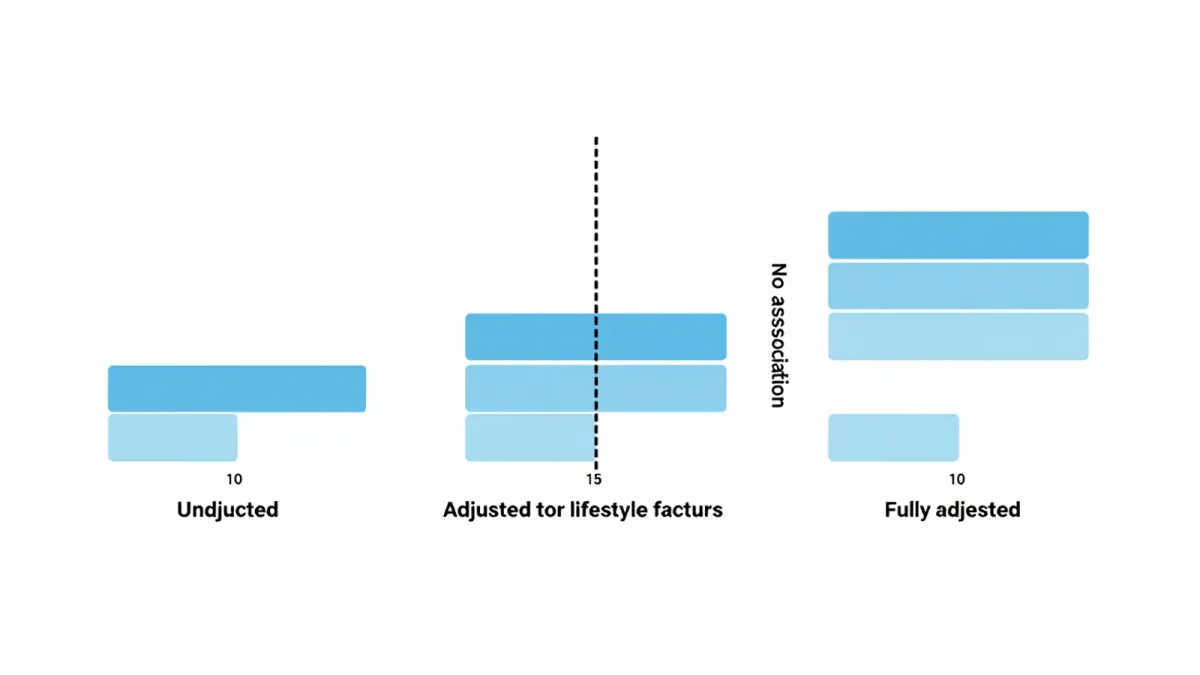
Researchers handle confounding statistically, adjusting for age, smoking, income, body weight and dozens of other covariates. Adjustment works and matters — unadjusted associations are far less trustworthy. But it only balances what was measured and measured well. Personality, long-term healthcare engagement, inflammation, and unrecorded diet quality are exactly the hard-to-measure confounders that generate spurious nutrition findings. Two technical details in the paper tell you a lot: how much the effect shrank across adjustment models (reported stepwise in most tables), and whether the authors ran sensitivity analyses, such as excluding early deaths or restricting to never-smokers, which test whether the association behaves like a causal one.
- Dose-response gradient: risk falling steadily with each increment of exposure is weak evidence for causation, because confounders rarely track dose so neatly.
- Consistency across populations: the same association in different countries, cohorts and designs strengthens the case.
- Plausible mechanism: an association backed by biology carries more weight than an isolated statistical surprise.
These are elements of the well-known criteria attributed to the epidemiologist Austin Bradford Hill — not a checklist that proves causation, but a lens for grading plausibility.
Case-control: the fast, fragile cousin
A related design deserves its own label in your reading kit. Case-control studies start from the outcome: people who already have a disease are compared with similar people who do not, and past exposures are reconstructed — often by interview. They are fast and efficient for rare diseases, and they produced one of epidemiology's greatest achievements, the smoking-lung cancer work of Doll and Hill in the 1950s. But memory is a biased instrument: patients search their pasts for causes, controls do not, a distortion called recall bias, and selection of appropriate controls is notoriously delicate. When a headline rests on a case-control finding, the recall problem alone justifies waiting for a cohort to confirm.
Effect sizes: why small associations dominate headlines
Sample size is the quiet driver of the genre. With 500,000 participants, tiny differences reach statistical certainty automatically: a 4 percent difference in some cancer across quintiles of broccoli consumption is publishable, and press offices publish it. But small observational effects are also the most vulnerable to residual confounding, because a bias of a few percent is invisible in the noise. Most credible epidemiologists treat relative risks under roughly 1.3 — a 30 percent elevation — as weak signals unless replicated relentlessly, precisely because known confounders produce biases of that magnitude routinely. When the headline effect is large — the smoking-lung cancer relative risks ran to multiples, not percentages — the causal case stands on different ground.
The honest way to use an observational finding
Treat it as a question worth asking, not an instruction worth following. The questions that matter: has this association appeared in more than one independent cohort; is there a plausible mechanism; is there any randomized evidence, even indirect; and is the proposed behavior change harmless anyway? For most lifestyle findings that survive scrutiny — vegetables, movement, sleep, not smoking — the advice was boring before the study and remains boring after it, which is itself informative: headlines rarely change what a Mediterranean-pattern diet and regular walks were already going to tell you. For interventions with risk — supplements at high doses, extreme diets, off-label drugs — an observational association alone is never a sufficient basis for action, and the drug-era example of beta-carotene supplements is the standing lesson: observational data suggested benefit, randomized trials in smokers found harm, and the episode is now textbook material.
What to do with the next linked-to-lower-risk headline
Read past the headline to four items: the study design (cohort, case-control, randomized), the effect size with its confidence interval, whether the authors call it an association, and what has been found before. If the effect is small, novel, and unadjusted for anything you cannot measure, file the finding under interesting. If it confirms a decade of converging evidence, treat it as one more brick in a wall that was already standing. Either way, the observational study has told you what it can — the error is asking it to testify beyond that.