If a supplement bottle says "FDA approved," the label is breaking the rules. No dietary supplement receives FDA approval before sale. Under the Dietary Supplement Health and Education Act of 1994, known as DSHEA, a company can legally market a new supplement without showing the FDA that it works, and often without notifying the agency at all. Understanding that mechanic explains most of what consumers find confusing about the supplement aisle — and it defines exactly what protections shoppers do and do not have.
This article publishes information, not medical or insurance advice. Product choices with health consequences deserve a conversation with a clinician or pharmacist, particularly if you take prescription drugs.
What DSHEA actually changed
Before 1994, supplements occupied a gray zone between food and drugs, and the FDA had begun moving to tighten control. DSHEA resolved that fight in favor of the industry: it formally defined dietary supplements as products taken by mouth containing a "dietary ingredient" — vitamins, minerals, herbs, amino acids, enzymes or extracts — intended to supplement the diet. The law classified supplements as a subcategory of food, not drugs. That single classification drives everything: drugs must prove safety and efficacy through clinical trials before marketing; supplements do not, per the FDA's own guidance.
DSHEA also created the structure/function claim category, allowing labels to say a product "supports immune health" or "helps maintain normal cholesterol" as long as the label carries the disclaimer that the FDA has not evaluated the statement. What a supplement label may never claim is to diagnose, treat, cure or prevent a disease — that language turns the product into an unapproved drug.
What companies must do before selling
The obligations are thinner than most consumers expect:
- Old ingredients. For ingredients marketed in the US before October 15, 1994, no premarket notification is required at all.
- New dietary ingredients. For ingredients not marketed before that date, a manufacturer must submit a "new dietary ingredient" notification with evidence the ingredient is reasonably expected to be safe, 75 days before sale. The FDA reviews and can object, but many notifications are never filed, and industry estimates over the years have suggested a substantial share of new products skip the step.
- Good manufacturing practices. Since 2007–2010, firms must follow cGMP rules for identity, purity, strength and composition, and must test their products.
- Adverse event reporting. Since 2007, companies must report serious adverse events to the FDA, and labels must carry an address for consumer reports.
What happens after a product is on shelves
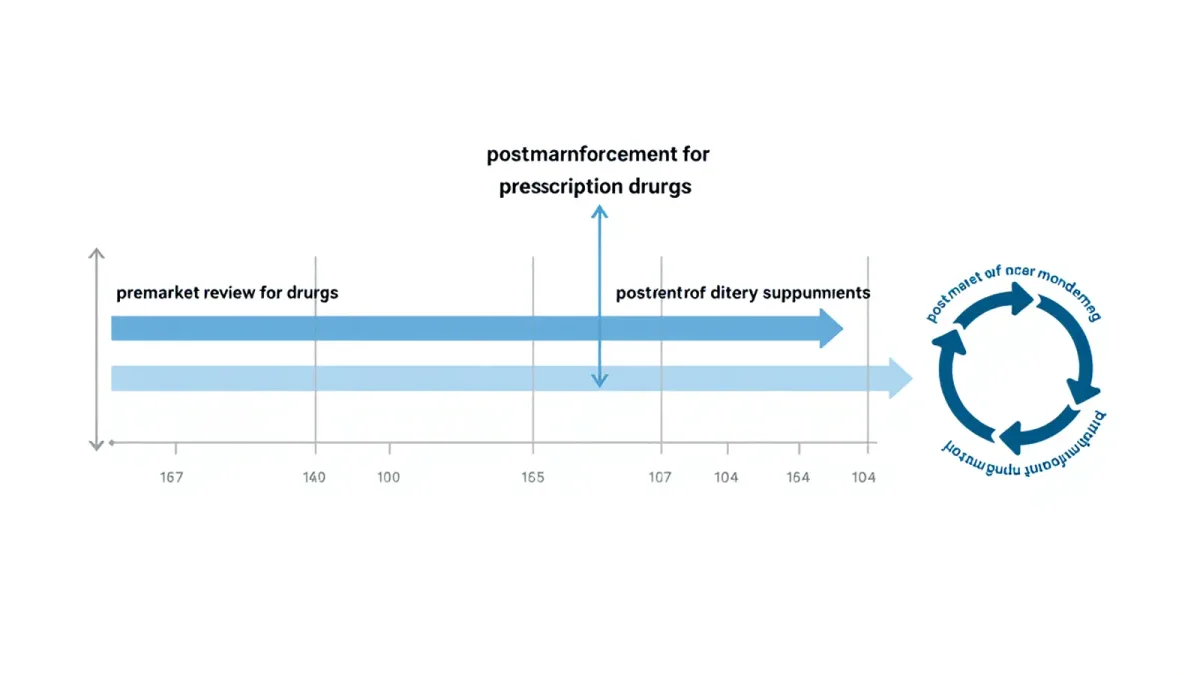
Enforcement is post-market and reactive. The FDA can issue warning letters — most commonly for disease claims on websites, or for products found to contain undeclared drug ingredients. That second category is the sharpest edge of supplement regulation: FDA laboratory analyses have repeatedly found hidden prescription drugs in products sold for weight loss, sexual enhancement and bodybuilding, including sibutramine (withdrawn from the market as a drug) and undeclared sildenafil. The agency maintains public databases of tainted products and recalled supplements, and consumers can report problems through the MedWatch system. The Federal Trade Commission polices advertising truthfulness in parallel.
Why "natural" does not mean "safe"
DSHEA's framework treats an ingredient's pre-1994 presence in commerce as a proxy for safety. But dose, contaminants and interactions do not respect that assumption. High-dose green tea extract has been linked in case series to liver injury; according to the NIH's National Center for Complementary and Integrative Health, herb-drug interactions such as St. John's wort — which accelerates the metabolism of many prescription drugs, including some antidepressants, birth control and anticoagulants — are well documented. Kava, comfrey and ephedra illustrate the range: ephedra was the one high-profile full ban, withdrawn by FDA rule in 2004 after deaths and thousands of adverse event reports, a process that took a decade.
How to use the system as a shopper
Four habits convert this legal knowledge into practice. First, ignore approval language; instead look for third-party certification seals such as USP Verified or NSF Certified for Sport, which test what labels claim. Second, read claims literally: "supports" and "maintains" are structure/function phrases with no efficacy review behind them. Third, search the product name with the word "recall" or check the FDA's tainted-products lists, especially for weight-loss, sports and sexual-health categories. Fourth, tell your pharmacist what you take — interaction checks run on complete lists, and supplements are part of the list even when prescriptions are not.
Does the law cover everything sold online?
DSHEA covers products intended for ingestion, which leaves gaps the marketplace exploits. The law also contains a wrinkle called the food-additive exclusion: an ingredient approved as a new drug before it was marketed as a food supplement cannot be used in supplements without a specific FDA allowance. NAC (N-acetyl cysteine) sat in that gray zone for years until the FDA announced enforcement discretion in 2022, allowing supplement use while the question is reconsidered. Cannabidiol illustrates the other boundary: CBD was approved as the drug Epidiolex in 2018, which under the same exclusion blocks routine supplement use, yet CBD products flooded retail shelves anyway and the agency told Congress in 2023 that it needed new statutory authority to regulate them.
Online marketplaces add one more layer: products shipped from abroad may never appear in any FDA database until an inspector or a poisoned consumer finds them. The agency's import alerts and warning letters catch a fraction, which is why third-party certification and pharmacy-channel purchases carry more signal than marketplace reviews.
What to watch
Congress has debated post-DSHEA reforms repeatedly, including mandatory product listing, which would give the FDA a registry of what is actually being sold; as of early 2026 no such requirement has been enacted. FDA leadership has also flaggedannaboid products such as CBD as a category the 1994 law was never designed to handle, leaving them in regulatory limbo. The durable takeaway: under current law, the supplement aisle is buyer-beware by design, and the shopper's own verification habits are the working substitute for premarket review.