
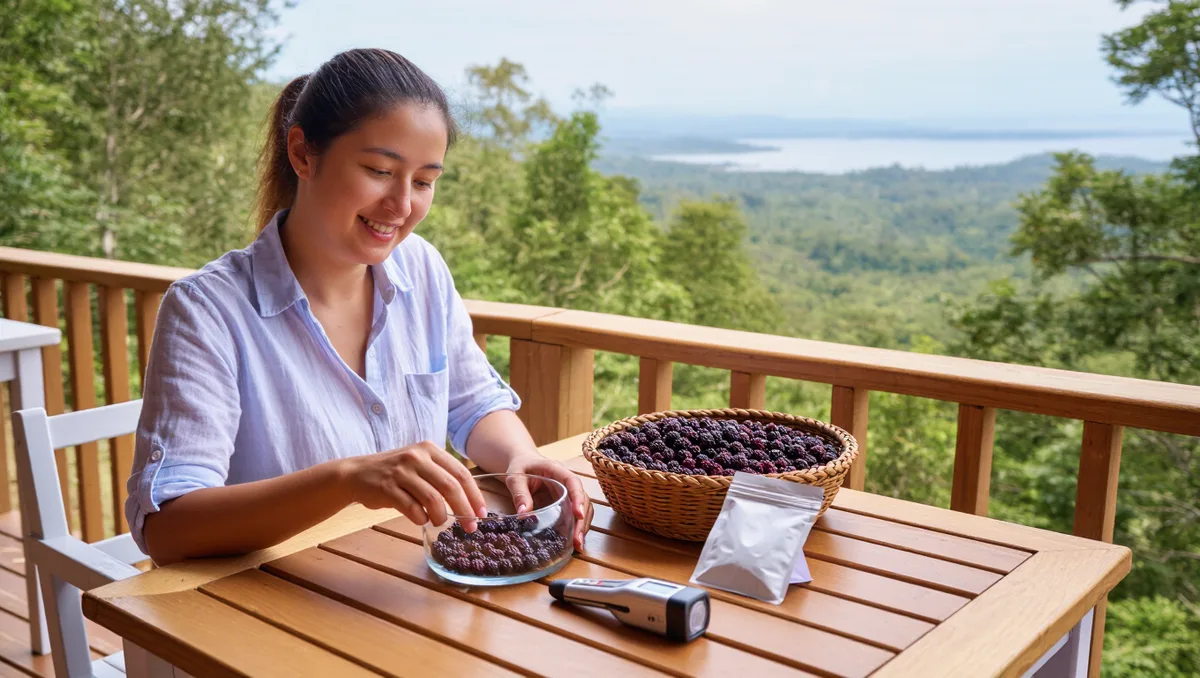
Maqui berry is a purple fruit from the temperate rainforests of southern Chile and Argentina, and the honest answer to what it can do for your health is: less than the marketing suggests, though not nothing. According to News-Medical, the berry has a higher anthocyanin content than many other berries, and a systematic review of 12 clinical reports found that acute doses of standardized maqui extract generally reduced the rise in blood glucose after a meal, especially in people with impaired glucose regulation.
The qualification matters. Most of the eye-catching findings come from cell cultures and animal studies. Human trials have not established benefits for lifespan, age-related cognitive decline, bone disorders, or skin aging. This piece unpacks what the berry actually contains, what the different grades of evidence show, and where the research is headed. This connects to our earlier piece, Same Weight Loss, Different Health Gains: What the Keto Trial Found.
What exactly is in a maqui berry?
Anthocyanins are the plant pigments that make berries purple, and maqui is unusually rich in them. Among 19 polyphenolic compounds identified in the fruit, delphinidin-derived anthocyanins make up the largest share, while quercetin derivatives represent most of the flavonol fraction. One anthocyanin, delphinidin 3-O-β-glucoside, is among the compounds studied for effects on cellular signaling pathways involved in redox balance, according to News-Medical.
Chemical profiling has also detected fatty acids, phytosterols such as β-sitosterol, and smaller phenolic constituents including gallic, ellagic, and protocatechuic acids. The catch: the relative contributions of these compounds to effects in humans remain uncertain.
Does the antioxidant story hold up?
Oxidative stress happens when reactive oxygen species — unstable molecules that damage cells — outpace the body's antioxidant defenses. Lab assays that measure free radical scavenging, such as the DPPH and ORAC methods, show strong antioxidant capacity in maqui extracts, particularly water and ethanol extracts in cell-free systems.
But a cell-free assay does not tell you what happens after you swallow the berry. Intact anthocyanins generally have low systemic bioavailability, meaning only a small proportion reaches circulation unchanged — often reported at about 1% or less. Circulating metabolites may also contribute to biological activity, according to News-Medical. Preclinical research links anthocyanins to the Nrf2 pathway, a regulator of the body's own antioxidant enzyme production, but whether maqui compounds reach the brain in sufficient concentrations to be protective remains unresolved.
What does the anti-inflammatory evidence show?
Cell culture research offers mechanistic clues, not proof of benefit. In human colorectal cancer cell lines, maqui extracts reduced nitric oxide production, COX-2 protein expression, and NF-κB expression. These effects were concentration-dependent and strongest in the anthocyanin-rich fractions. News-Medical is direct about the limit: these experiments provide mechanistic evidence with no established benefit for cancer treatment. For related coverage, see FDA Approved Hepcludex, Closing the US Gap in Hepatitis D Treatment.
In one experimental colitis model, maqui extract reduced inflammatory index scores and altered gut bacterial populations after induced intestinal injury. Most mechanistic findings, though, come from cells and animals, which limits conclusions about systemic anti-inflammatory effects in humans.
What about aging, skin, and metabolism?
The aging research is early-stage. In rodent models, maqui extract given before ozone exposure reduced oxidative stress markers and prevented deficits in memory and learning. In cell cultures, maqui extracts reduced cigarette smoke-induced oxidative injury in human osteoblasts at selected concentrations — though higher concentrations could be cytotoxic. A slight protective effect against UVB exposure appeared in cultured human skin fibroblasts. None of this has been confirmed in human trials.
Metabolic outcomes are the main area of clinical research. The systematic review found that acute dosing with standardized maqui extract generally blunted the post-meal glucose rise. Inhibition of intestinal SGLT1 — a glucose transporter in the gut — is a proposed mechanism that still requires confirmation in humans.
How is maqui berry consumed?
The evidence pack describes the berry as a fruit with traditional roots: Mapuche communities in southern Chile historically used maqui preparations, particularly from leaves, for wound care and fever. Modern researchers now explore the fruit as a source of antioxidant compounds. For readers tracking the supplement evidence beat, the key distinction is between standardized extracts used in clinical reports and the whole fruit or powders sold commercially — the review's glucose findings apply to standardized extract dosing, not to any product on a shelf.
What should a reader take from this?
The strongest supported point is narrow: acute doses of standardized maqui extract reduced the post-meal glucose rise in clinical reports, especially in people with impaired glucose regulation. Everything else — brain protection, skin aging, bone health, inflammation in the body at large — sits at the cell-and-animal stage. Human trials have not established those benefits, and the proposed SGLT1 mechanism needs confirmation. For more on how early-stage findings get reported, see our research coverage and our supplements hub.
What remains unknown is the dosing question for real-world use, the long-term effects of regular consumption, and whether any of the preclinical signals translate to people. Those are the studies to watch for in health news coverage of this fruit.