
Vitamin D is one of the most studied and most oversold supplements in the United States. Roughly one in four American adults takes a supplement containing it, per National Health and Nutrition Examination Survey data, and Americans spent an estimated $1 billion a year on vitamin D products before 2020. What the evidence supports is narrower than the shelf suggests: vitamin D supplementation clearly helps prevent and treat deficiency and supports bone health in specific groups, while large trials have largely failed to confirm benefits for heart disease, cancer prevention or all-cause mortality.
Decisions about testing or supplementation belong with a clinician who knows your health history, especially if you have kidney disease, sarcoidosis or take medications that interact with vitamin D.
What does vitamin D actually do?
Vitamin D helps the intestines absorb calcium and phosphorus, which is why deficiency in children causes rickets and in adults causes osteomalacia — soft, weak bones. The body also uses vitamin D in immune cell signaling and muscle function. The Food and Nutrition Board sets the adult Recommended Dietary Allowance at 600 IU (15 micrograms) daily up to age 70 and 800 IU (20 micrograms) after 70, with an upper safe limit of 4,000 IU for adults, per the National Institutes of Health Office of Dietary Supplements.
Where is the evidence strongest?
The strongest indications are specific:
- Treatment of deficiency. Supplementation reliably raises blood levels of 25-hydroxyvitamin D and reverses deficiency symptoms.
- Bone health with calcium. Combined calcium and vitamin D supplements reduce fracture risk in institutionalized older women, a finding supported by pooled trial data.
- Rickets prevention. The American Academy of Pediatrics recommends 400 IU daily for infants, breastfed or not, because breast milk contains little vitamin D.
What have large trials shown?
The VITAL trial, published in the New England Journal of Medicine in January 2019, followed 25,871 US adults for a median of 5.3 years. Vitamin D 2,000 IU daily did not significantly reduce major cardiovascular events or invasive cancer compared with placebo. An accompanying analysis found no significant reduction in cancer mortality. The D2d trial, reported in 2019, found 4,000 IU daily did not significantly lower diabetes progression in people with prediabetes over about 2.5 years, though a 2023 secondary analysis suggested a possible benefit in the subgroup not taking supplements.
A 2022 randomized trial in Australia enrolled more than 21,000 adults aged 60 and older and found daily vitamin D 60,000 IU per month did not reduce fractures compared with placebo — contradicting the assumption that supplementation protects bones in generally healthy, non-deficient community dwellers. Taken together, the trial record supports a consistent message: benefits shown in deficient populations do not automatically extend to replete people taking mega-doses.
D2 or D3 — does the form matter?
Supplements come as vitamin D2 (ergocalciferol, usually from irradiated yeast) and vitamin D3 (cholecalciferol, usually from lanolin or lichen). Head-to-head randomized comparisons and pooled analyses suggest D3 raises and maintains blood 25-hydroxyvitamin D levels slightly more efficiently, but both forms correct deficiency when dosed adequately. The larger practical difference is dose per pill: D3 products commonly carry 1,000 to 5,000 IU per softgel, which makes accidental long-term overdose easier than most buyers assume.
Can food and sun cover it?
Few foods naturally contain meaningful vitamin D: fatty fish such as salmon and sardines, egg yolks and UV-exposed mushrooms. Most dietary vitamin D in the US comes from fortified milk, plant milks, orange juice and breakfast cereals. Sun exposure synthesizes vitamin D in the skin, but the amount depends on latitude, season, skin tone, age and sunscreen use, and dermatologists caution that deliberate tanning adds skin cancer risk. For people in northern states, winter synthesis effectively stops from roughly November through February, which is why seasonal deficiency is common, and why a modest supplement is often more practical than chasing midwinter sun.
How is deficiency actually diagnosed?
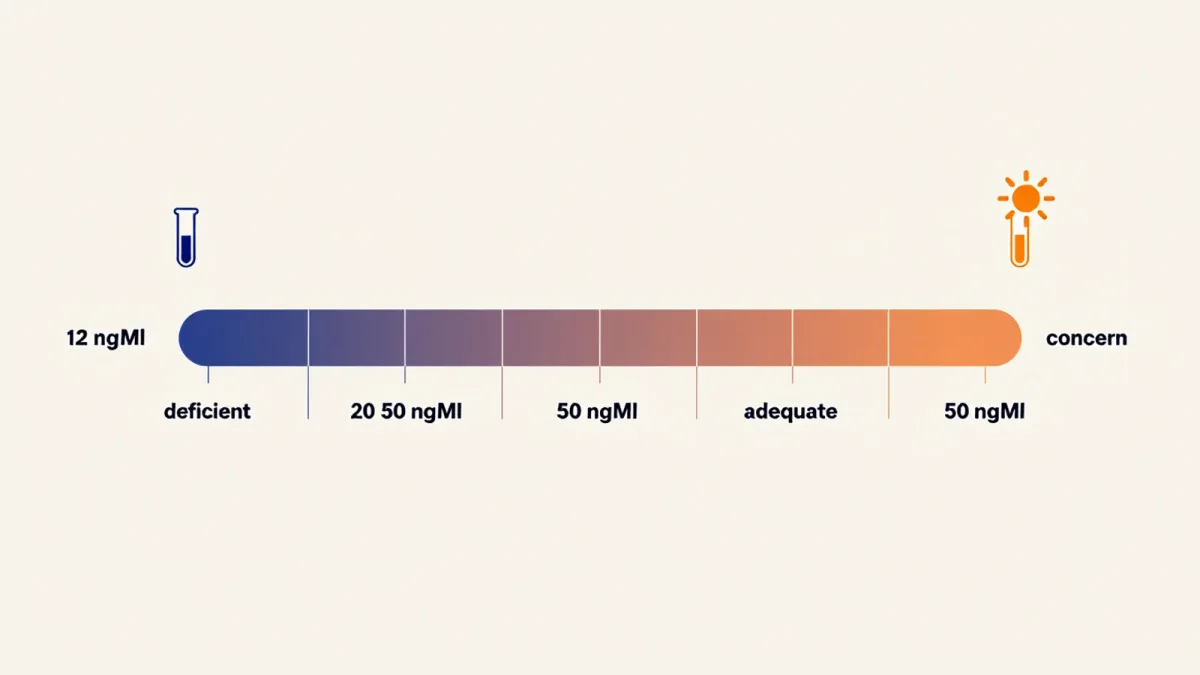
Labs report 25-hydroxyvitamin D in ng/mL or nmol/L (multiply ng/mL by 2.5 to convert). The National Academy of Medicine considers 20 ng/mL (50 nmol/L) adequate for most people; many commercial labs flag anything below 30 ng/mL as insufficient, a cutoff with weaker trial support. That gap between adequate and optimal is where a large share of vitamin D supplement sales originates. If you are tested, ask what cutoff your clinician is using and why.
How much is too much?
Vitamin D is fat-soluble and accumulates. Sustained intake above 4,000 IU daily without monitoring can push blood levels past 100 nanomoles per liter and cause hypercalcemia — nausea, vomiting, weakness, frequent urination and, over time, kidney stones and kidney injury. Case reports in the NIH literature describe patients hospitalized after taking 50,000–100,000 IU daily for months on their own. Testing sounds like the obvious safeguard, but routine screening of healthy adults is debated: the US Preventive Services Task Force has concluded evidence is insufficient to assess screening's benefit in asymptomatic, non-pregnant adults.
Why does the marketing oversell it?
Under the Dietary Supplement Health and Education Act of 1994, supplement makers are not required to prove efficacy before sale. Structure/function claims such as "supports immune health" are legal with a disclaimer and do not require premarket review, per the FDA. Observational studies that link low vitamin D to dozens of diseases are real but confounded — people with chronic illness spend less time outdoors, so low vitamin D often marks illness rather than causing it. When trials test the vitamin directly, most of those associations fail.
What should a reader do differently?
If you rarely get sun, have dark skin, live at northern latitudes or are over 65, a modest supplement of 600–800 IU daily is a reasonable, low-risk choice most guidelines tolerate. Do not start high-dose regimens without a clinician's input, and treat "immunity booster" labels as marketing until trials say otherwise. Watch for 2026 results from ongoing trials of vitamin D in autoimmune disease and respiratory infection — those will either broaden or further shrink the proven case.